Author: Manus AI
Published on: February 4, 2026
Do you have a visceral, deep-seated aversion to "walls of text"? When an important PDF file or a long report appears on your screen, does your heart beat faster, your palms start to sweat, and your mind go blank, as if an invisible barrier of shame and anxiety has suddenly slammed down between you and the words?
You are not alone. This feeling, which we call "Reading Trauma," is not a formal clinical diagnosis, but it is a real experience that resonates deeply within the ADHD community. It's not simply "disliking reading," but a complex, conditioned psychological trauma, accumulated and fermented over years from countless failed attempts, misunderstood glances for reading slowly or remembering poorly, and self-doubt and negativity born from the inability to complete reading tasks.
Today, this article isn't about productivity, efficiency, or even techniques. We are only here to talk about healing. We want to gently and patiently dissect the roots of this trauma with you and provide a concrete, actionable roadmap to reconnect with words in an absolutely safe environment.
The core of this roadmap is a unique tool—the ADHD Reading extension. It is not a stern coach demanding you "try harder" or "be more focused," but a gentle companion whispering, "It's okay, let's take it slow, you are in control." It will help you tear down the wall of "fear" step by step, embarking on a healing journey from fear to love, from surviving to thriving.
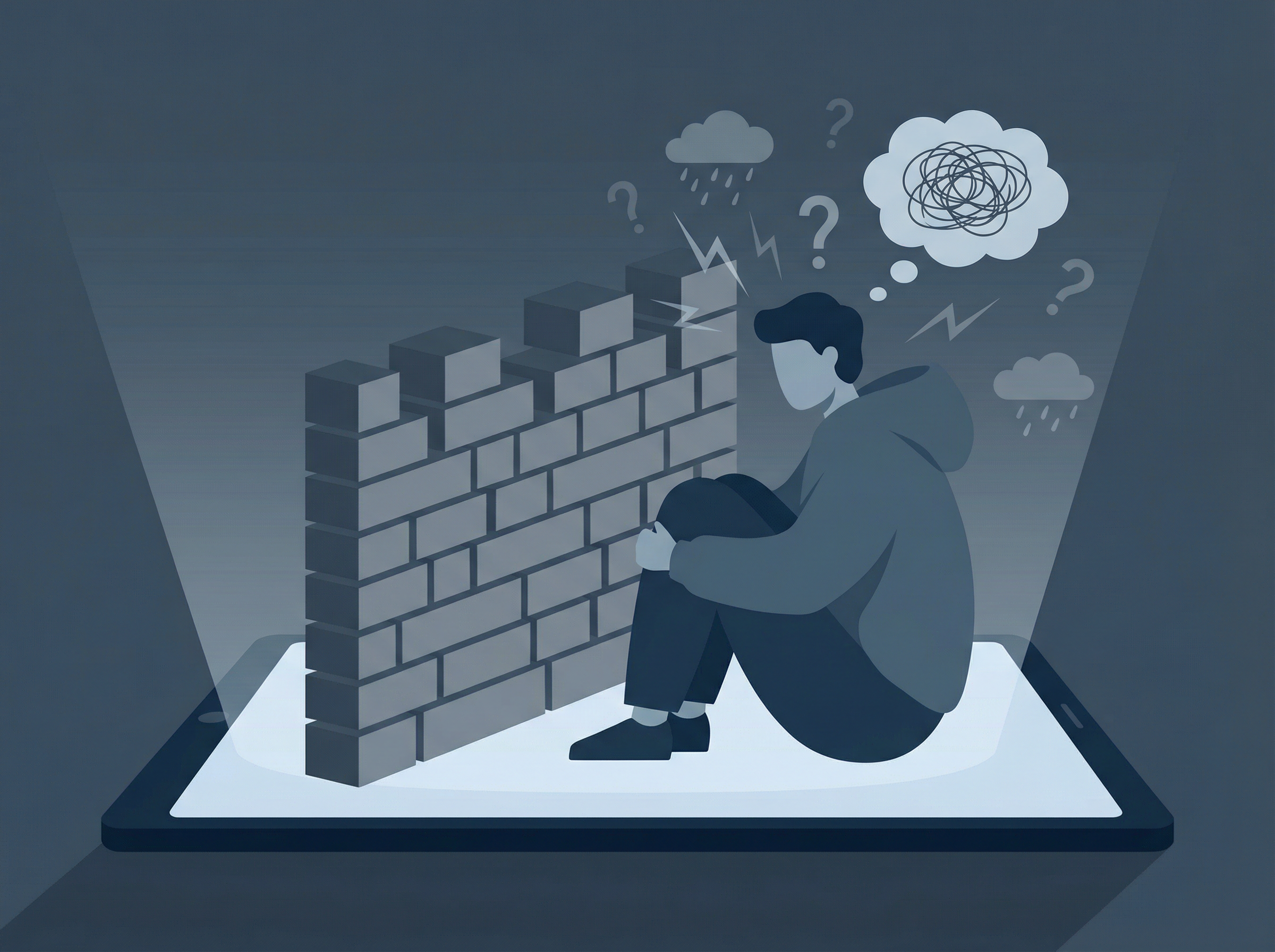
Faced with an impenetrable "wall of text," the ADHD brain often falls into a state of physiological anxiety and avoidance.
Part 1: The Anatomy of Reading Trauma—Why Do We Fear Words?
To heal a wound, we must first understand how it was formed. Reading trauma doesn't come from nowhere; it's a self-reinforcing vicious cycle constructed from negative experiences, physiological reactions, and psychological defense mechanisms.
The Vicious Cycle of Shame and Avoidance
You might be intimately familiar with every step of this cycle:
-
The Trigger: A task appears. Your boss sends a 30-page industry report, or your professor assigns a paper full of academic jargon. You are faced with an insurmountable "wall of text."
-
The Physical Alarm: Your amygdala—the brain's "threat detection center"—is activated. It mistakenly identifies the "wall of text" as a threat, sounding the alarm for the Fight-or-Flight Response. Your body starts secreting cortisol and adrenaline, leading to a rapid heartbeat, shortness of breath, and muscle tension.
-
The Cognitive Shutdown: In this state of stress, the function of the most advanced and energy-consuming part of the brain—the prefrontal cortex—is suppressed. This area is crucial for executive functions (like attention, working memory, and emotional regulation). This means the more anxious you are, the more your "reading brain" goes on strike.
-
The Behavioral Response: To escape this extremely uncomfortable feeling, you unconsciously adopt various avoidance strategies:
- Procrastination: "I'll grab a coffee first," "I'll answer a few emails first." You do anything but start reading.
- "Fake Reading": This is the most common and insidious survival strategy. Your eyes move across the text, looking like you're reading, but your mind is blank, and no information is being processed. It's a camouflage technique evolved to avoid being called out in meetings or classes.
- Complete Abandonment: After multiple failed attempts, you directly label the task as "impossible" and find various rationalizations for it.
-
The Emotional Fallout: Avoidance behavior temporarily alleviates physical anxiety but brings deeper psychological pain. You feel intense guilt ("I've wasted another day"), shame ("Why can't I even do something this simple?"), and despair ("I'm a failure").
-
The Belief Solidification: Each cycle reinforces a catastrophic core belief: "I'm just not cut out for reading." This belief further lowers your self-efficacy, causing you to have a stronger physical alarm the next time you face a "wall of text." The cycle closes and spirals downward.
The High Cost of "Fake Reading": We must recognize that "fake reading" is a highly intelligent adaptive strategy developed to survive in unaccommodating educational and professional environments. But its cost is enormous. It not only makes you miss the knowledge itself but also continuously depletes your cognitive energy, leaving you in a state of performance fatigue from "acting normal." This is a major reason why many people with ADHD feel exhausted after a day of work or study.
The Catalytic Role of the Social Environment
Reading trauma is not entirely internal. It is often catalyzed and exacerbated by the external environment. Growing up, we may have heard things like:
- From teachers: "You're smart, you just don't apply yourself." (Misinterpreting neurodivergence as an attitude problem)
- From parents: "Look at the neighbor's kid, they can read a book a day. Why can't you sit still?" (Inducing comparison and shame)
- From colleagues: "This report is simple, why did it take you so long?" (Causing workplace stress and self-doubt)
These uncomprehending, judgmental words are like salt repeatedly rubbed into our wounds, making us even more certain that the problem lies with us.
Part 2: The Three-Step Healing Method—Rebuilding Your Reading Safe Zone with ADHD Reading
Healing reading trauma is like soothing a frightened animal. You can't force it; you can only create an absolutely safe, benevolent, and controlled environment to slowly and tentatively lure it out of its cave. The design philosophy of the ADHD Reading extension perfectly aligns with this healing process. It's not a cold tool but an empathetic, customizable "safe space."
Step 1: Separation and Empowerment—Reclaim Your Sense of Control with "Typography Control"
Healing Goal: To completely separate "self-worth" from "reading performance" and reclaim a Sense of Control over the reading environment. One of the core experiences of trauma is "loss of control," so the first step of healing must be to experience "everything is under control."
ADHD Reading's Role: At this stage, it's not a reading tool but an "environment design tool." Its "Typography Control" feature is your first key to reclaiming control.
Your Healing Exercise (15 minutes):
- Choose Your Material: Find a web article that you have absolutely no interest in and no pressure to read. A gossip piece about a celebrity you don't know, or an introduction to a niche hobby. Choosing something inconsequential ensures your brain won't feel extra pressure to "understand" it.
- Enter "Design Mode": Open the ADHD Reading extension and go to the "Typography Control" menu. Now, forget about reading. Imagine you are a graphic designer working on an art piece. Your task is not to "read" but to "play."
- Radical Transformation:
- Adjust the font size to a level you find "exaggerated." Feel the text transform from a "threat" into "friendly symbols."
- Maximize the letter spacing and word spacing. Feel the "breathing room" between the words and the pleasure of "dismantling" the "wall of text" with your own hands.
- Try different preset modes and observe the different psychological feelings each one brings. Which one makes you feel the most "safe" and "calm"?
- Inner Dialogue Practice: As you make adjustments, repeat this sentence to yourself in your mind: "This is my space, and I'm in charge. My comfort is more important than anything else."
The core purpose of this exercise is to break the feeling of helplessness that "webpages are fixed, and I must adapt to them." By personally transforming a stressful environment, you are telling your brain through action: "I am the master here, and I have the power to make the environment adapt to me." This experience of control is the cornerstone of healing.
By customizing the typography, you are no longer a passive recipient but the designer of your reading environment.
Step 2: Focus and Exploration—Establish Your Safe Path with the "Focus Guide"
Healing Goal: To re-experience "pressure-free focus" in a controllable, distraction-free environment and break the conditioned reflex of "wanting to escape at the sight of text."
ADHD Reading's Role: At this point, it transforms into a silent and patient guide. Its "Focus Guide" feature will lay down a safe, clear, and fork-free path for your exploration.
Your Healing Exercise (10 minutes):
- Maintain a Safe Environment: Use the typography settings you created in the previous step that make you feel most comfortable.
- Light the First Lamp: Activate the "Focus Guide" feature. You'll see that only the first paragraph of the article is bright, while everything else gently recedes into the shadows. The whole world seems to be just you and this small piece of text.
- Redefine the "Task": Your task is now greatly simplified. It is not to "understand this paragraph" or even "finish reading this paragraph." Your task is merely to "let your gaze rest in the area illuminated by this light for 30 seconds." You can read, not read, look at a single word, or even daydream. The only requirement is: do not leave the light.
- Tentative Steps Forward: When you feel ready, gently and consciously move your mouse to shift the beam of light to the next paragraph. Feel the certainty and security of "lighting one lamp at a time." You only ever have to face the small step in front of you, without worrying about the long road ahead.
- Allow Distractions, Gently Guide Back: During this process, your mind may still wander. That's okay. When you realize you're distracted, don't judge or blame yourself. Just gently, like guiding a lost child, bring your attention back to the beam of light.
This exercise uses a variation of "behavioral exposure therapy" to reshape your neural pathways. It tells your frightened amygdala: "Look, the world inside this light is safe; there is no danger." By repeatedly experiencing this "pressure-free focus," you are gradually disarming the false alarm that equates "text = threat."
The "Focus Guide" is like a spotlight, leading you one small step at a time to build a solid sense of security.
Step 3: Flow and Connection—Rediscover the Rhythm of Words with "Smart Emphasis"
Healing Goal: To switch from the struggling mode of "deciphering word by word" to the flowing mode of "feeling the rhythm," and ultimately to create a genuine emotional or intellectual connection with the content.
ADHD Reading's Role: Now, it's a skilled "music conductor." Its "Smart Emphasis" module will inject the rhythm and cadence of life into static, lifeless text.
Your Healing Exercise (5 minutes):
- Choose "Engaging" Material: Now, you can choose an article you are genuinely interested in. A review of a movie you like, a report on a sport you love. It's crucial to choose content that touches your emotions or curiosity because we need the help of dopamine.
- Enter "Dance Mode": While maintaining the "Focus Guide" and your comfortable typography, try activating a "Smart Emphasis" mode.
- First, try "Bionic Reading" or "Semantic Bolding." Close your eyes, take a deep breath, then open them. Don't "try to read"; just relax your gaze and feel how your eyes begin to unconsciously jump along with the bolded letters or words. Experience the feeling of gliding smoothly instead of pushing laboriously.
- Then, try "Semantic Highlighting." Feel how it acts like accent marks in music, indicating the ups and downs of the content without interrupting the melody.
- Find Your "Heartbeat Rhythm": Try adjusting the emphasis density. Does a faster "allegro" (high density) excite you, or does a more soothing "adagio" (low density) calm you? Find the "cognitive tempo" that best matches your current state of mind.
- Celebrate Small "Connections": During this process, you might suddenly find that you've understood a long sentence, resonated with one of the author's points, or even laughed. Stop immediately, identify, and celebrate this tiny moment of "connection." Tell yourself: "Look, I did it. I not only read, but I also felt it."
The essence of this exercise is to help you rediscover the joy of reading. When reading is no longer a task to be fought with willpower, but a flowing experience where you can immerse yourself and feel its inner rhythm, "love" for it will quietly, unexpectedly arrive.
Conclusion: Your Reading Story, Rewritten by You
From gaining a sense of control with "Typography Control," to establishing a sense of security with the "Focus Guide," and finally finding rhythm with "Smart Emphasis," the ADHD Reading extension provides a unique digital space to systematically heal reading trauma through a carefully designed, psychotherapy-based "three-step therapy."
Let's review this journey: you are no longer a helpless victim facing a "wall of text," but an environment designer with a powerful tool, a brave explorer on a safe path, and a rhythmic dancer who can feel the cadence of words.
This process may not happen overnight. Healing is a spiral-up process, and you may have setbacks. But now, you have a "safe base" to which you can always return. Whenever you feel anxious or overwhelmed, go back to Step 1, back to that fully controlled, benevolent space.
It's time to stop blaming yourself, to stop struggling in a world not built for you. Your reading story should not end in fear and frustration. From today, you get to write a new chapter of reconciliation, control, and rediscovered joy.
Visit adhdreading.org to download the reading companion made for you
Install for free from the Chrome Web Store now and begin your healing journey
Your new reading story begins with this choice of kindness and courage.