Author: Manus AI
Published on: February 4, 2026
Have you ever stared at an important piece of text, feeling like you recognize every word, but they're just a pile of sand that refuses to form a meaningful structure in your mind? Or have you read an article three, five, or even ten times, only to have the information evaporate from your brain the moment you close the book, leaving behind a blank space and deep frustration? You might also find yourself procrastinating for hours, paralyzed by the inability to start reading an important report, ultimately being labeled "lazy," "inattentive," or "not trying hard enough" by yourself or others.
If this sounds familiar, please take ten minutes to read this article that could change your reading life. We want to tell you a groundbreaking fact: There's nothing wrong with your brain; you've just been using the wrong tools.
For too long, we've lived under a default misunderstanding, trying to force our unique brains to adapt to a world designed for the "neurotypical." Dense text on web pages, paragraphs lacking visual guidance, and ubiquitous pop-ups and ads—these elements of modern digital interfaces are, for a brain with Attention-Deficit/Hyperactivity Disorder (ADHD) traits, like asking an athlete in snow boots to run a 100-meter dash. It's not a matter of willpower, but a fundamental mismatch of tools.
But today, this long, exhausting war can end. We now have a revolutionary weapon born specifically for the unique neural structure of your brain—the ADHD Reading extension. It's not another tool that makes you "try harder" to fit into the world, but a personalized solution that makes the digital world adapt to you. This article will, from a neuroscience perspective, decode the three main reasons why reading is so difficult for the ADHD brain and detail how each feature of the ADHD Reading extension acts like a precision scalpel, hitting the pain points to fundamentally reshape your reading experience.
Part 1: Deep-Dive—Why is Reading So Difficult for the ADHD Brain?
To defeat an enemy, you must first understand them. The challenges the ADHD brain faces in reading are far more complex than just "distraction." They primarily stem from three core deficits in the brain's Executive Functions, which profoundly affect our attention, memory, and motivation systems.
Enemy #1: The Uncontrolled "Spotlight"—Visual Noise and a Deficit in Inhibition
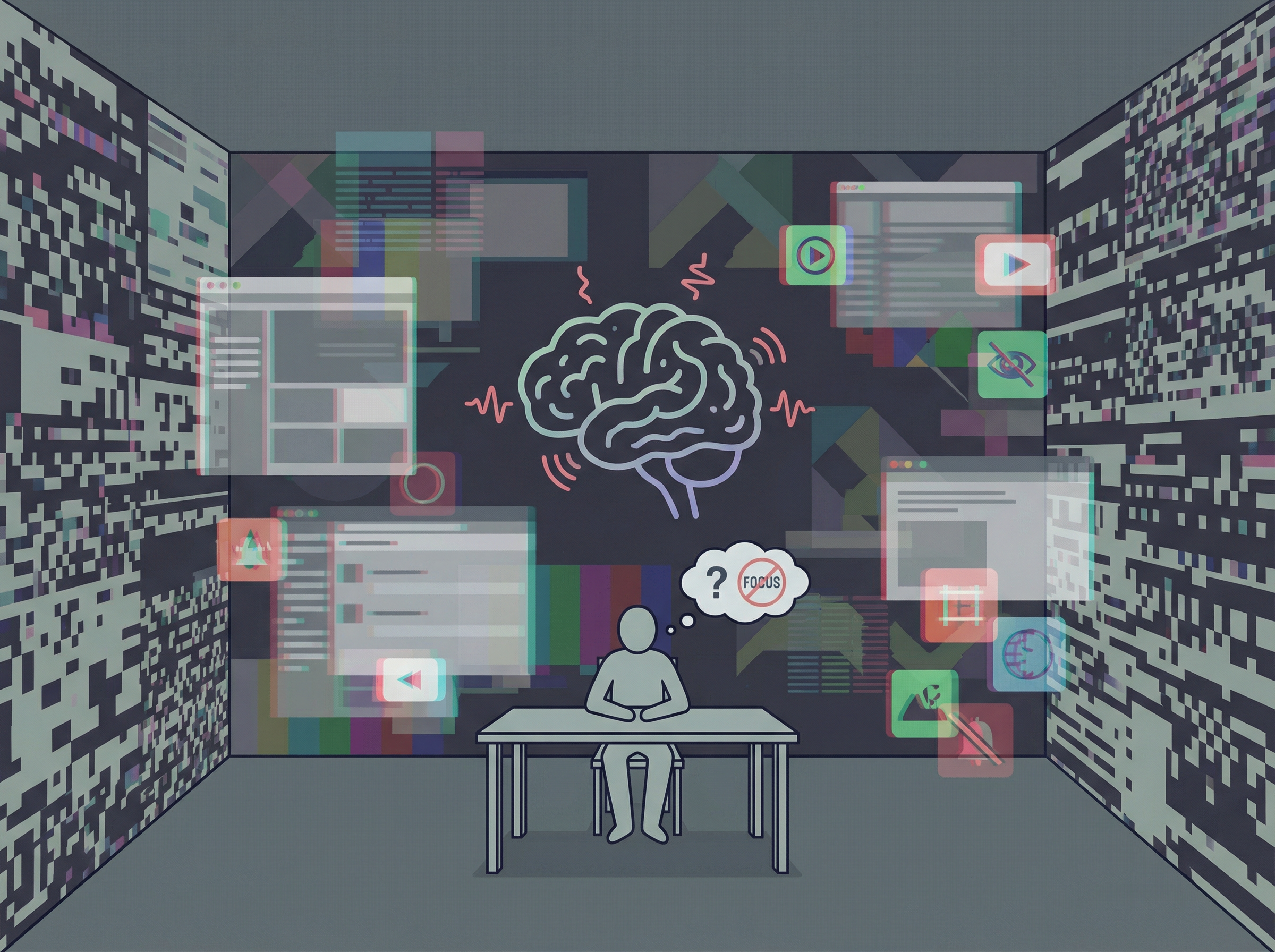
Imagine you're at a noisy party, trying to hear a friend whispering in your ear. It's nearly impossible because your auditory system is overwhelmed by countless irrelevant sounds—music, laughter, conversations at the next table. For the ADHD brain, reading a chaotically designed webpage is like attending such a never-ending party.
The neurological basis for this phenomenon lies in the relatively weaker function of "Inhibitory Control" in the Prefrontal Cortex. Inhibitory control acts like an efficient filter or "party host" in our brain, actively ignoring all stimuli irrelevant to the current task to ensure our "cognitive spotlight" illuminates only the most important information. However, research shows that this "filter" in the ADHD brain has significant differences, making it difficult to suppress internal and external interference [1].
When reading a webpage, this means:
- Inability to filter external visual noise: Your gaze is involuntarily drawn to flashing ads, colorful images, or even a bolded word in a nearby paragraph. Each of these elements competes for your limited attentional resources.
- Difficulty suppressing internal mind-wandering: When you read a word, you might immediately think of something unrelated, and then your thoughts run wild like an untethered horse. By the time you snap out of it, you've completely forgotten where you were reading.
- Increased sensitivity to the "visual crowding" effect: "Visual Crowding" is the phenomenon where the ability to identify an object significantly decreases when other objects are nearby. For ADHD readers, dense text, tight line spacing, and narrow margins on a webpage greatly exacerbate this crowding effect, making it exceptionally difficult to recognize and decode individual words [2].
For the ADHD brain, an un-optimized webpage is like a noisy party that interferes with normal attention.
Enemy #2: The Leaky "Basket"—Working Memory Overload
Working Memory is often compared to the brain's "temporary RAM" or a "cognitive sticky note." It's a limited-capacity system responsible for temporarily storing and processing information while performing complex tasks like language comprehension, reasoning, and learning. According to the classic model proposed by psychologist Alan Baddeley, working memory is primarily regulated by the "Central Executive" and includes subsystems like the "Phonological Loop" and the "Visuospatial Sketchpad" [3].
Reading is, in essence, a process that heavily relies on working memory. You need to:
- Use the "Phonological Loop" to mentally sound out words.
- Use the "Visuospatial Sketchpad" to track the position of text on the page.
- Use the "Central Executive" to combine decoded words into sentences, connect sentences into paragraphs, and link them with your existing knowledge to form understanding.
Numerous studies confirm that one of the core features of ADHD is a deficit in working memory, particularly in central executive function [4]. This causes the ADHD brain to act like a leaky basket when reading:
- Information decays quickly: Newly read information (like the first half of a long sentence) leaks out of the "basket" before it can be processed. This forces you to reread repeatedly, searching for the subject or key concept that was there just a moment ago.
- Capacity is easily overloaded: When faced with complex sentences containing multiple clauses, or story plots requiring you to process multiple character relationships simultaneously, the already limited-capacity "basket" quickly "overflows," leading to cognitive collapse and a blank mind.
- Poor resistance to interference: An irrelevant thought or an external sound can easily "wash out" the little information that was in the "basket."
By reducing the underlying decoding load, ADHD Reading provides an external support structure for working memory.
Enemy #3: The Empty "Fuel Tank"—Task Initiation Difficulty and Lack of Motivation
The saying "the first step is the hardest" might be ten times harder for individuals with ADHD. This isn't laziness or a lack of willpower, but is determined by an imbalance in the regulation of a key neurotransmitter in the brain—Dopamine.
The dopamine system, particularly the Mesolimbic Pathway, is our brain's "motivation and reward engine." By releasing dopamine, it makes us anticipate potential rewards and drives us to perform behaviors that can obtain those rewards [5].
However, the ADHD brain's dopamine system has two main characteristics:
- Lower baseline levels: The brain's dopamine levels in a resting state are relatively low.
- Preference for immediate rewards: For activities that provide immediate, high-intensity feedback (like playing video games or scrolling through social media), the dopamine system is very active. For tasks that require delayed gratification and have long reward cycles (like reading a thick book or completing a report), it becomes "stingy," unwilling to secrete enough dopamine to "initiate" the behavior.
Therefore, when you face a dense wall of text, your brain conducts a subconscious "cost-benefit analysis." It anticipates this will be a "chore" that consumes immense cognitive energy (high cost) but provides no immediate pleasure (low reward). Because there isn't enough "motivational fuel" (dopamine) in the "tank," you feel a strong internal resistance, making it difficult to start the act of "reading." This phenomenon is clinically known as "Task Initiation Difficulty."
| Reading Challenge | Neurological Root | Specific Manifestation in Reading |
|---|---|---|
| Distraction | Weak Inhibitory Control (Prefrontal Cortex) | Gaze wanders on the page, drawn to ads, images; mind easily wanders to other things. |
| Comprehension & Memory Issues | Small & Inefficient Working Memory (Central Executive) | Forgetting the beginning of a sentence by the end; needing to reread long sentences; difficulty understanding complex structures and remembering key info. |
| Procrastination & Avoidance | Dopamine Dysregulation (Mesolimbic Pathway) | Feeling daunted or irritated by large blocks of text; difficulty starting reading tasks, even important ones. |
Part 2: How ADHD Reading Becomes Your Brain's "External Hard Drive"
After understanding these three deep-rooted "enemies," when you look at the design of the ADHD Reading extension, you'll find that each of its features is like a precision neurosurgical scalpel, targeting the root cause and providing powerful external support for your brain—a perfect "brain enhancement."
Solution #1: Rebuild Your "Fortress of Focus" with the "Focus Guide"
"It's like a spotlight you personally control, illuminating only your chosen protagonist in a dark theater, letting all irrelevant backgrounds and noises fade into darkness, and the world instantly becomes quiet."
To combat "visual noise" and "inhibitory difficulty," neuroscientists have found "Peripheral Visual Suppression" to be an extremely effective method. By technologically highlighting the central area of the visual field, it actively suppresses the brain's processing of peripheral interference, thus transforming a passive, strenuous "internal filtering" into an easy, automatic "external filtering" [6].
The "Focus Guide" feature of ADHD Reading is the perfect engineering implementation of this cutting-edge scientific principle. When you activate it, your screen instantly transforms from a noisy marketplace into a carefully arranged stage. Only the current paragraph where your mouse cursor is located remains clear and bright, while the rest of the page elegantly and quietly darkens. It's like an intelligent spotlight that faithfully follows your reading rhythm, creating a quiet, orderly, and absolutely focused reading space for you.
How to maximize the effect of the "Focus Guide"?
- Personalize your "beam": The extension allows you to customize the color of the highlight and the opacity of the background. You can choose a color that makes you feel calm (like a light blue or soft green) and increase the background opacity to create a fully immersive "focus beam" that is all your own.
- Use it as a reading pacer: Consciously use your mouse movements to control your reading speed. When you finish a paragraph, smoothly move the mouse to the next one. This combination of physical action and cognitive activity can help you maintain a steady reading rhythm and prevent your mind from drifting too quickly or slowly.
- Combine it with the "two-minute rule": If you have trouble starting a reading task, make a deal with yourself: just use the "Focus Guide" to read for two minutes. Usually, after you've been immersed in this distraction-free environment for two minutes, the resistance to starting the task will have been overcome.
User Testimonial: "I used to get lost in a Wikipedia rabbit hole, clicking one link after another, and half an hour later I'd be miles away from my original topic. After using the 'Focus Guide,' I can finally finish reading an entire article. It didn't force me to focus; it just removed everything I could get distracted by." — A college student's review
Solution #2: Offload Your Working Memory with "Smart Emphasis"
"Reading is no longer the arduous task of pushing a boulder up a hill, but a smooth glide on a carefully laid track."
To solve the problem of "working memory overload," the core idea is to reduce the cognitive load of the "decoding" process, thereby freeing up precious cognitive resources for higher-order "understanding" and "memory" processes. The Bionic Reading® technology, which has gained widespread attention in recent years, works by bolding the first part of words, providing the eyes with a series of regular visual "anchors." This guides the eyeballs to perform faster, more coherent "saccades" instead of struggling word by word, creating a "cognitive tunnel" effect that allows the brain to recognize words and group them into meaningful phrases more quickly [7].
Bolded word beginnings act like visual anchors, guiding the eyes to jump efficiently between words.
The ADHD Reading extension not only integrates this powerful technology but also offers richer, more personalized options. Its "Smart Emphasis" module includes three carefully designed modes:
- Bionic Reading: The classic mode, which forces your gaze to jump quickly and rhythmically through the text by bolding the initial letters of words. It's especially suitable for scenarios requiring quick scanning and information filtering.
- Semantic Bolding: Backed by a more complex natural language processing algorithm, it intelligently analyzes sentence structure and bolds only the keywords that carry core information (like nouns, verbs, and key adjectives). This helps you grasp the main structure of a sentence at a glance, perfect for reading information-dense content like news and reports.
- Semantic Highlighting: Compared to bolding, this is a gentler visual guide. It uses soft background colors to highlight key information, guiding attention without causing strong visual stimulation, making it an excellent choice for users prone to visual fatigue.
The most crucial innovation is that ADHD Reading allows you to freely adjust the emphasis density from 20% to 60%. This means you can, like adjusting the tempo of music, find the "cognitive rhythm" that feels most comfortable and makes your reading most fluent, based on the difficulty of the text and your mental state. When the decoding process becomes effortless, your working memory "basket" will no longer leak, but will easily load, process, and retain information.
Solution #3: "Fuel" Your Motivation with "Typography Control"
"You are no longer passively accepting a stressful interface, but actively becoming the designer of your own reading world."
Remember the "task initiation difficulty" and the empty "dopamine tank" that made us cringe? The psychological principle behind this is "Cognitive Comfort." A crowded, cluttered, and breathless layout greatly increases our visual stress and cognitive load, and the brain's instinctive reaction is to "escape," because it anticipates this will be a high-energy activity.
The "Typography Control" feature of ADHD Reading gives you the ultimate power to completely reshape this interface. It's like a professional typographer's toolbox, allowing you to, with just a click:
- Infinitely adjust the font size, making every word clear and friendly, and saying goodbye to the pain of squinting at small text.
- Freely increase letter and word spacing, injecting precious "air" between the text, making the layout instantly feel fresh and breathable.
- Apply various preset comfort modes with one click, or perform fine-tuned personalized adjustments until you feel the page was made for you.
This process itself is empowering and healing. When you can actively transform a daunting interface into a "work of art" that makes you feel comfortable, pleasant, and aesthetically pleased, the "resistance to starting" reading is greatly reduced. Your brain no longer sees it as a threat, but as a safe, controllable, and even interesting challenge. This makes it possible to artificially create a "dopamine reward": every time you successfully beautify and read an article, you are creating a new positive feedback loop for your brain—"it turns out reading can be easy and enjoyable."
Conclusion: Stop Adapting to the World, Let the World Adapt to You
By building a "fortress of focus" with the "Focus Guide," "offloading" your working memory with "Smart Emphasis," and "fueling" your motivation with "Typography Control," the ADHD Reading extension systematically and comprehensively addresses the core pain points faced by ADHD readers in the digital world from a fundamental neuroscience level.
It's not just a tool, but a whole new paradigm, a powerful declaration: we have the right to demand that the digital world change for our unique brain structure, not the other way around. It respects your privacy, solemnly promising no user data collection; it embraces the world's diversity, having been deeply optimized for over 10 major languages.
Now is the time to stop the futile, soul-draining battle with webpage layouts that don't suit you. It's time to stop the endless self-doubt and blame. Take action now, empower yourself, and equip your unique and creative brain with the most powerful assistive tool it deserves.
Install the ADHD Reading extension for free from the Chrome Web Store now
Visit our official website adhdreading.org to learn more about the science behind it
Start enjoying an unprecedentedly smooth, focused, and efficient reading experience tailored just for you. Your brain deserves to be treated better.
References
[1] Castellanos, F. X., & Tannock, R. (2002). Neuroscience of attention-deficit/hyperactivity disorder: The search for endophenotypes. Nature Reviews Neuroscience, 3(8), 617-628.
[2] Yeshurun, Y., & Rashal, E. (2010). The role of attention in the crowding effect. Journal of Vision, 10(10), 1-1.
[3] Baddeley, A. (2003). Working memory: looking back and looking forward. Nature reviews neuroscience, 4(10), 829-839.
[4] Martinussen, R., Hayden, J., Hogg-Johnson, S., & Tannock, R. (2005). A meta-analysis of working memory impairments in children with attention-deficit/hyperactivity disorder. Journal of the American Academy of Child & Adolescent Psychiatry, 44(4), 377-384.
[5] Volkow, N. D., Wang, G. J., Kollins, S. H., Wigal, T. L., Newcorn, J. H., Telang, F., ... & Swanson, J. M. (2009). Evaluating dopamine reward pathway in ADHD: clinical implications. JAMA, 302(10), 1084-1091.
[6] Carrasco, M. (2011). Visual attention: The past 25 years. Vision Research, 51(13), 1484-1525.
[7] Bionic Reading. (n.d.). How Bionic Reading Works. Retrieved from https://bionic-reading.com/