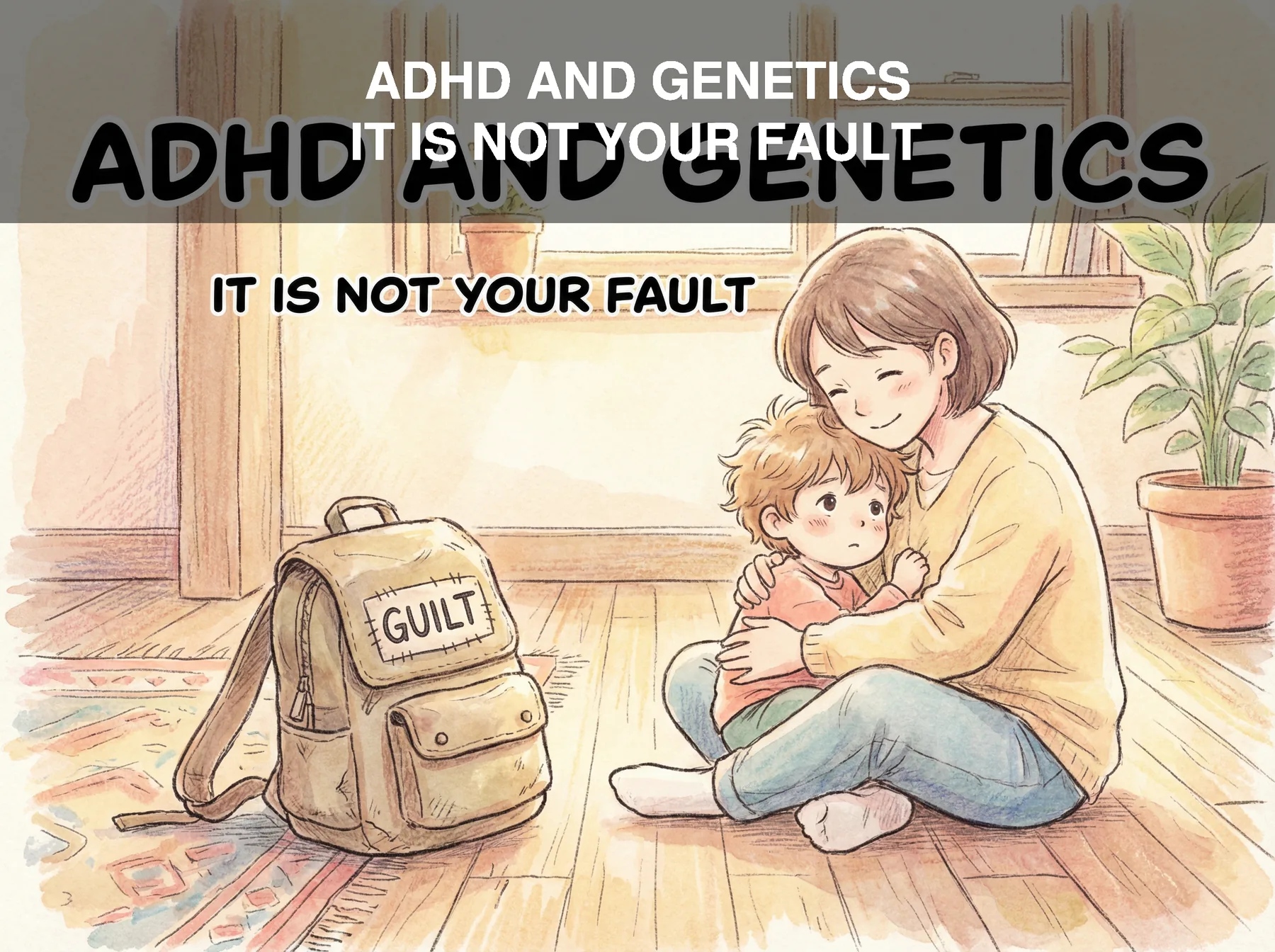
Do you remember the first time I heard a mother in the consultation room asking the doctor with a trembling voice: "Is it because I drank coffee when I was pregnant that he became like this?" At that moment, the self-blame in the air was suffocating.
If you have also asked yourself countless times in the middle of the night: "Did I do something wrong?" or "Is it because I was too playful when I was young that caused the current problems?"—Please stop this self-judgment immediately.
In this article, I will take you through a 3-minute scientific speed read to uncover the true biological code behind ADHD. After reading, you will find unprecedented relief and understand how to use this knowledge to take control.
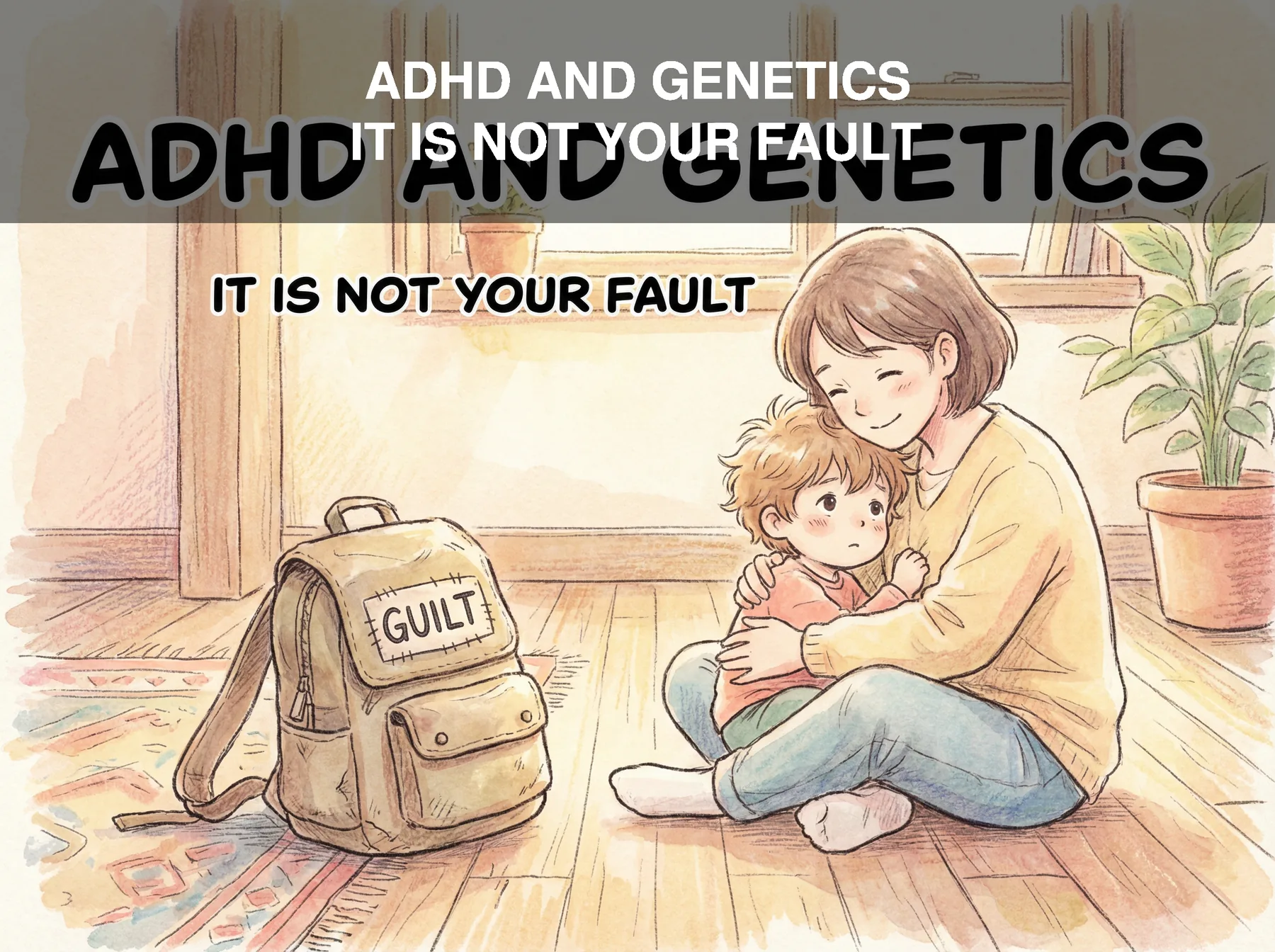 ADHD AND GENETICS — IT IS NOT YOUR FAULT
Illustration: ADHD AND GENETICS — IT IS NOT YOUR FAULT
ADHD AND GENETICS — IT IS NOT YOUR FAULT
Illustration: ADHD AND GENETICS — IT IS NOT YOUR FAULT
1. Accept the "Biological Blueprint": Heritability up to 80%
First, let's look at a shocking number.
The latest large-scale studies (covering children and adolescents globally) show that the heritability of ADHD is between 74% and 91%.
What does this mean? The heritability of height is about 80%. That is to say, the genetic predisposition for ADHD is almost the same as height; it is written in the genes.
Act Now: When your mind starts slipping into "character flaws" or "lack of discipline," take a deep breath and tell yourself: "This is the brain's hardware setting, just like my height. It is not my 'fault'." Acknowledging the biological basis is the first step to self-acceptance.
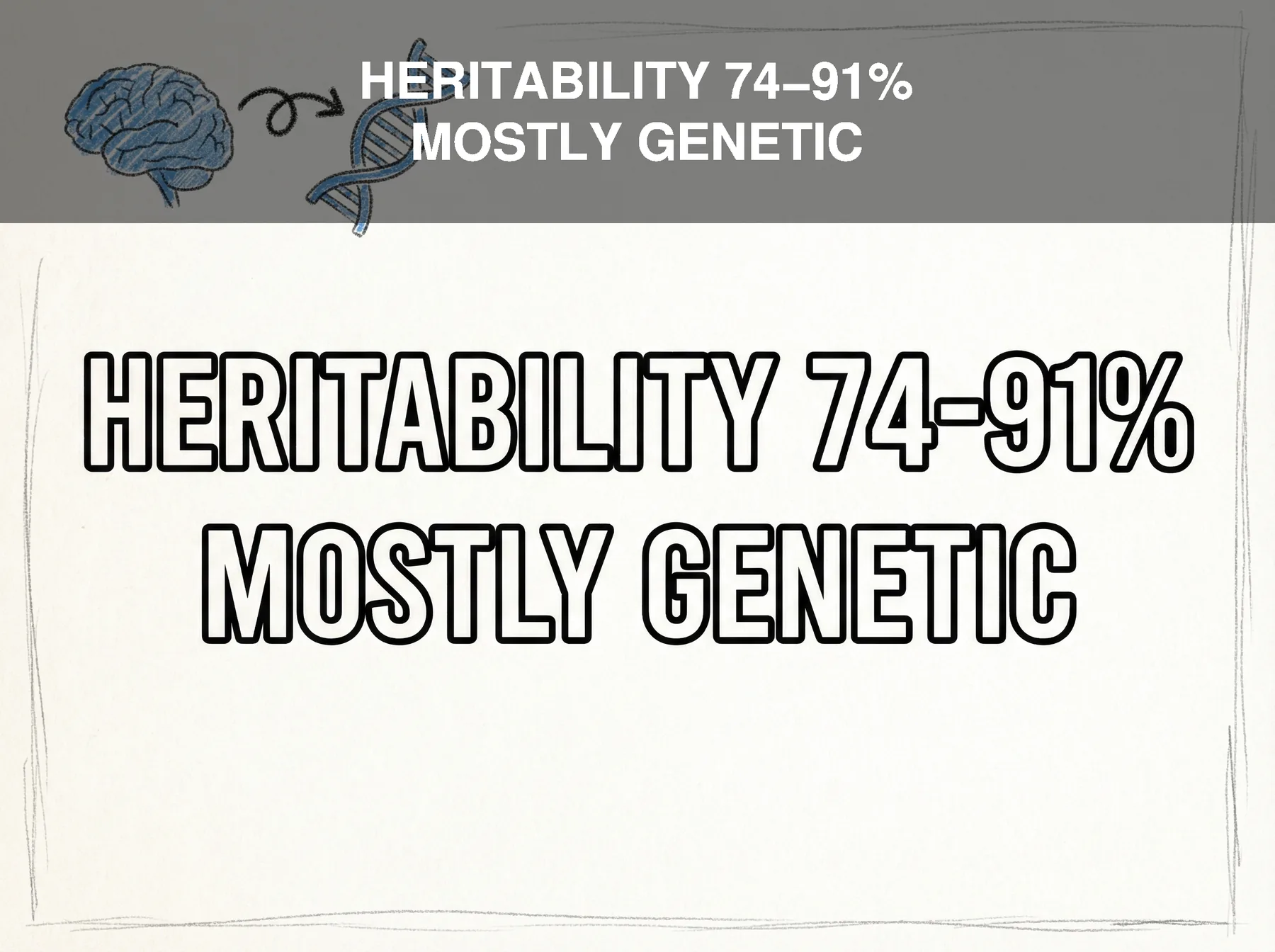 HERITABILITY 74-91% — MOSTLY GENETIC
Illustration: HERITABILITY 74-91% — MOSTLY GENETIC
HERITABILITY 74-91% — MOSTLY GENETIC
Illustration: HERITABILITY 74-91% — MOSTLY GENETIC
2. Drop the "Bad Parent" Script: Environment Is Not the Deciding Factor
Many parents worry that their parenting style caused their child's ADHD. But the adoption studies in the data give us the most powerful rebuttal.
Studies have found that for adopted children with ADHD, their symptoms are far more correlated with their biological parents (blood relation) than with their adoptive parents (who provide the growing environment).
What does this imply? Family education and discipline styles might affect the expression of symptoms, but they are definitely not the core cause of ADHD.
Act Now: Throw away the heavy burden of "because I didn't teach well" from your shoulders. Your task is not to "fix" a child you broke, but to support a life with a unique brain structure.
3. Understand the "Genetic Lottery": No Single "Switch"
Do not try to find a specific "ADHD gene" to take the blame. The current scientific consensus is: ADHD is the result of polygenic interaction.
This is like buying a lottery ticket; winning or losing is not decided by a single ticket, but by hundreds or thousands of tiny genetic variants (SNPs) stacking up together to push up the risk.
But this does not mean we are powerless against the environment. Although genes load the gun, the environment (such as stress, lifestyle) is often the hand that pulls the trigger.
Act Now: Since we cannot change the genes (Hardware), let's focus on optimizing the "Operating System" (Environment).
- Regular Exercise: Increase dopamine secretion.
- Minimalist Environment: Reduce sensory overload.
- Positive Feedback: Establish a reward mechanism suitable for the ADHD brain.
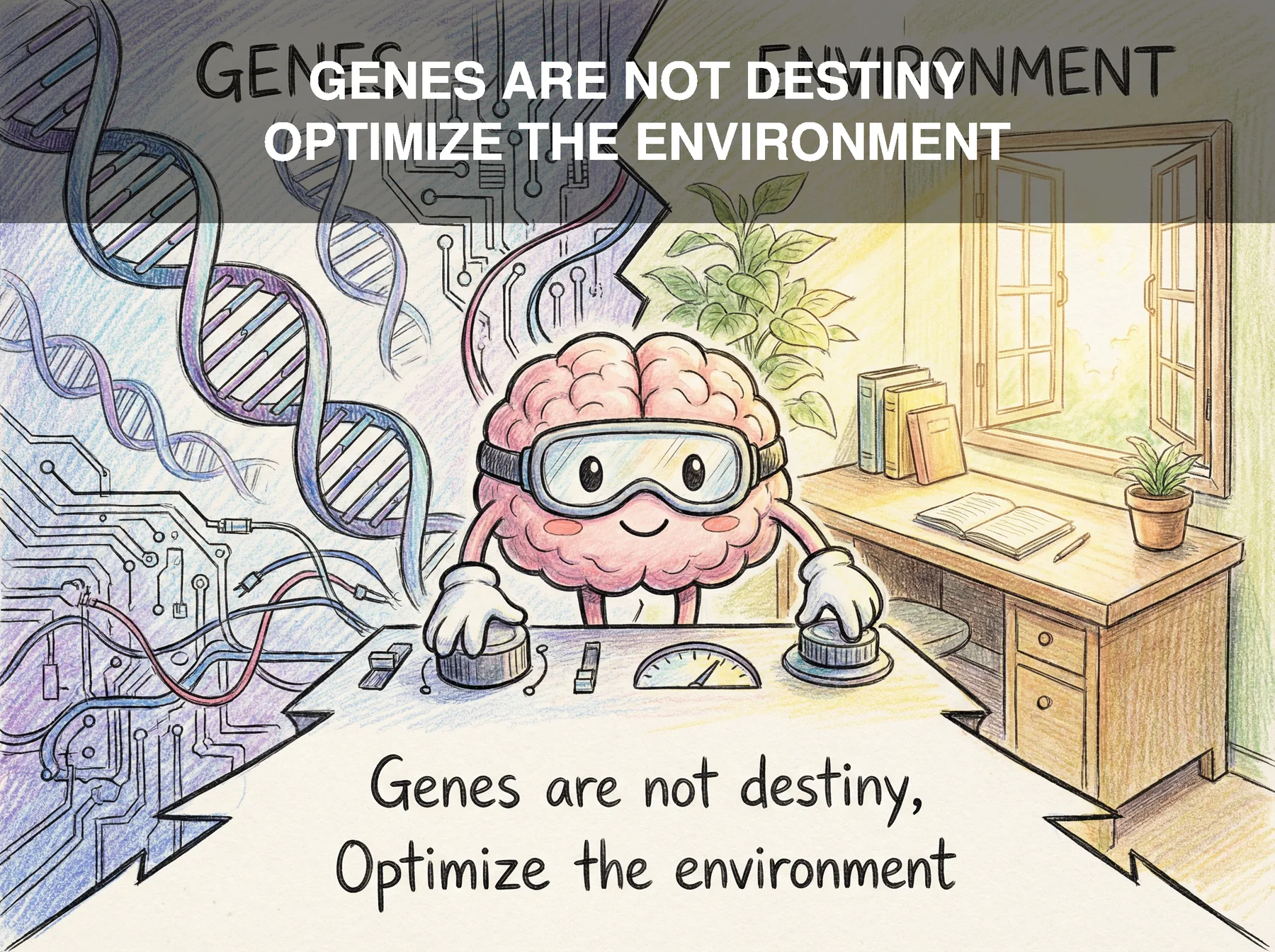 GENES ARE NOT DESTINY — OPTIMIZE THE ENVIRONMENT
Illustration: GENES ARE NOT DESTINY — OPTIMIZE THE ENVIRONMENT
GENES ARE NOT DESTINY — OPTIMIZE THE ENVIRONMENT
Illustration: GENES ARE NOT DESTINY — OPTIMIZE THE ENVIRONMENT
💡 The Bottom Line
ADHD is not a failure of parenting, but a highly heritable neurobiological trait.
Now that you know this is the "factory setting," please stop struggling in the quagmire of "why me." Starting today, shift your energy from self-blame to adaptation, and build an environment where your (or your child's) brain can shine.
Do It Now: Forward this article to any friend who is still feeling guilty about ADHD, and tell them: "It's not your fault; science has proven it."